

How to Start a Business Duct Cleaning Service Without Getting Clogged
Why Business Duct Cleaning Is a Smart Market to Enter Right Now
Business duct cleaning is one of the fastest-growing service niches in the commercial maintenance industry — and for good reason.
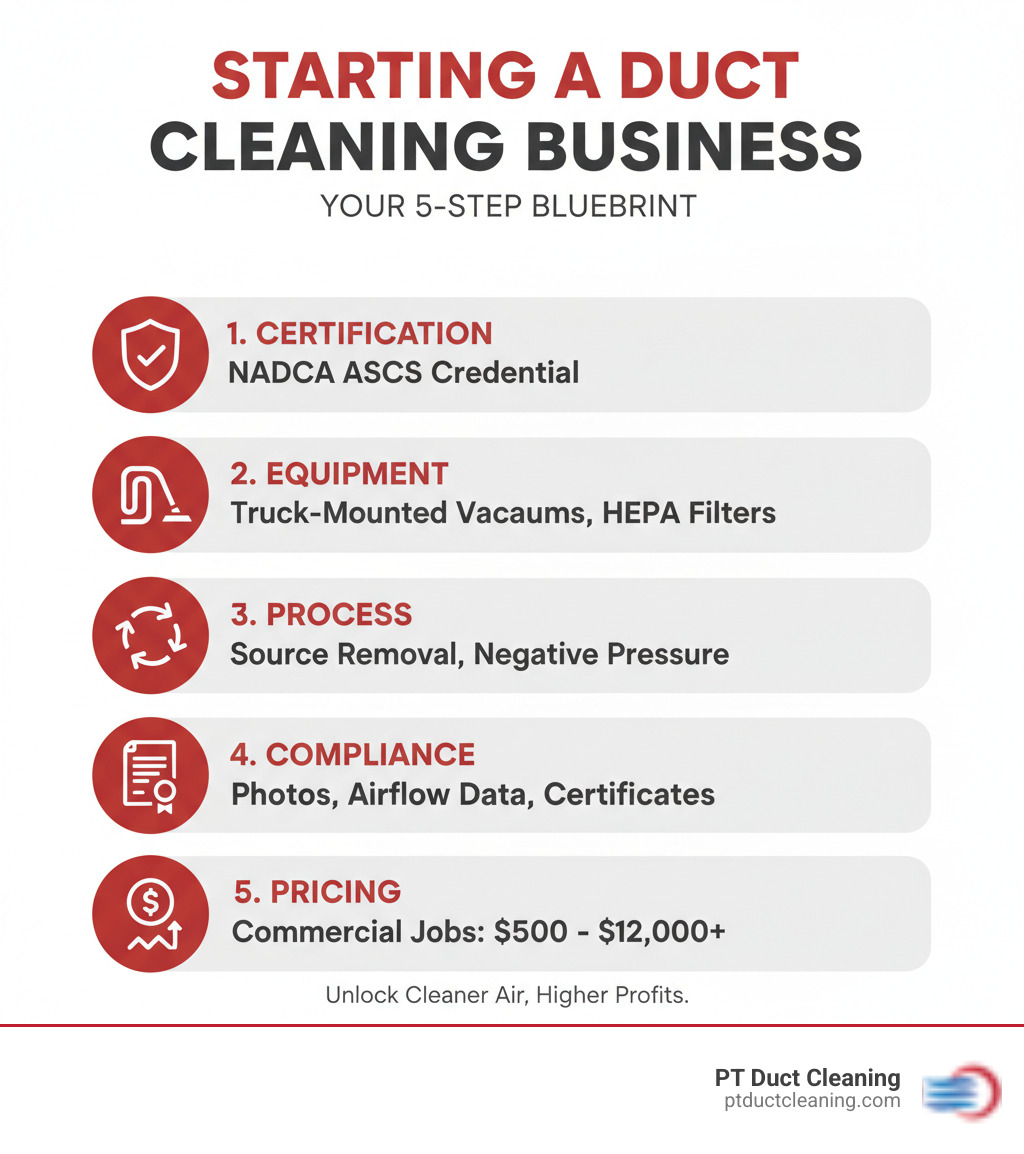
Here’s a quick overview of what starting a business duct cleaning service involves:
- Understand the market — Commercial buildings accumulate contaminants faster than homes due to higher occupancy and activity levels
- Get certified — NADCA certification (specifically the ASCS credential) is often required in commercial bids
- Invest in the right equipment — Commercial jobs need powerful systems like truck-mounted vacuums (5,000+ CFM) and HEPA filtration
- Learn the process — Source removal, negative pressure, mechanical agitation, and full component cleaning
- Handle compliance — Businesses need documentation: photos, airflow data, and compliance certificates
- Price your services — Commercial jobs range from $500 for small offices up to $12,000+ for large facilities
The demand is real. Poor indoor air quality (IAQ) costs U.S. businesses an estimated $150 billion annually in lost productivity. On top of that, dirty ducts can force HVAC systems to work 30-40% harder, driving up energy bills every single month.
That’s a problem businesses are actively looking to solve — and willing to pay a professional to fix.
Yet many markets, including the Chicago area, are underserved by qualified, certified commercial duct cleaners. Most providers focus on residential work and lack the equipment, training, or compliance knowledge that commercial clients require.
This guide walks you through exactly how to launch a professional business duct cleaning service — from picking your target industries and buying the right tools, to running your first commercial job and building long-term client relationships.
Understanding the Market and Essential Benefits

Entering business duct cleaning requires more than just a vacuum; it requires an understanding of why this service is a non-negotiable for modern enterprises. In the Chicago area, where HVAC systems run almost year-round to combat humid summers and freezing winters, the accumulation of debris is relentless.
Indoor air quality isn’t just a “nice to have”—it is a critical component of workplace safety and operational efficiency. When you explain Why Air Duct Cleaning is Essential to a business owner, you aren’t just selling a cleaning service; you are selling a solution to productivity loss and high overhead. According to the Environmental Protection Agency (EPA), indoor air can be significantly more polluted than outdoor air, impacting health and focus.
Statistics show that a typical building collects an incredible amount of dust and allergens. While a home might collect 40 pounds of dirt a year, commercial facilities—with their constant foot traffic and high occupancy—accumulate contaminants even faster. This buildup leads to:
- Energy Waste: Between 25% and 40% of the energy used for heating or cooling a commercial facility is wasted because air pollutants force the HVAC system to work significantly harder.
- System Strain: Just 0.42 inches of dirt on a heating or cooling coil can result in a 21% decrease in HVAC system efficiency.
- Reduced Longevity: Clean systems run up to 60% more efficiently, according to NADCA research, which translates to fewer mechanical breakdowns and a longer lifespan for expensive industrial units.
When building your business, you must emphasize Why You Should Clean Your Air Ducts in terms of ROI. A clean system isn’t just about breathing better; it’s about the bottom line.
Identifying Target Industries
To succeed, you need to know who needs you most. According to our Commercial Duct Cleaning Guide, different industries have varying requirements:
- Office Buildings: High-density environments where IAQ directly impacts cognitive function. Research from Harvard suggests that better air quality can increase productivity by 8–11%.
- Healthcare Facilities: Hospitals and clinics require stringent infection control. These clients often demand quarterly cleanings and rigorous documentation to meet JCAHO or OSHA standards.
- Restaurants: These facilities face unique risks, specifically grease accumulation. Failure to maintain these systems is a leading cause of commercial fires.
- Retail Spaces: High traffic means high dust. Clean ducts keep merchandise from getting dusty and ensure customers stay comfortable.
- Industrial & Manufacturing: These sites often deal with combustible dust, making professional cleaning a matter of fire safety and regulatory compliance.
The Financial Impact of Dirty Systems
The “productivity drain” caused by poor air quality is a massive $150 billion annual hit to U.S. businesses. For a local Chicago business, this might manifest as increased absenteeism—contaminated buildings see 35% to 50% higher rates of employee illness. By positioning your business duct cleaning service as a preventative health measure, you become a partner in their success rather than just another line item on their expense sheet.
Essential Equipment and Certification for Success
You cannot “fake it” in the commercial world. Professionalism starts with credentials. There are 3 Reasons to Hire Professional Duct Cleaning Service providers over “blow-and-go” scammers: expertise, equipment, and ethics.
To compete for commercial bids in Illinois, you should pursue NADCA (National Air Duct Cleaners Association) certifications. The ASCS (Air Systems Cleaning Specialist) and CVI (Certified Ventilation Inspector) credentials are often explicitly required in government and large corporate contracts. These certifications prove you understand source removal and negative pressure standards.
Selecting the Right Tools for Business Duct Cleaning
Commercial systems are massive. A residential vacuum won’t cut it. You will need:
- High-Power Extraction: Aim for vacuums capable of at least 5,000 CFM (Cubic Feet per Minute). Truck-mounted systems are the gold standard, though high-end portable HEPA units are necessary for high-rise buildings where hoses can’t reach.
- Agitation Tools: Rotary brushes, air whips, and pneumatic “skipper” balls are essential for dislodging stubborn debris from large-diameter ducts.
- Inspection Tech: Borescope cameras and robotic crawlers allow you to show the client exactly what is hiding in their vents—and prove you got it out.
Safety and Compliance Protocols
Working in a commercial environment involves risks. You must implement a Lockout/Tagout (LOTO) program to ensure HVAC fans don’t kick on while a technician is inside a duct. Furthermore, PPE (Personal Protective Equipment) is mandatory to protect your team from mold spores, lead dust, or chemical residues.
If you are servicing restaurants, you must adhere to NFPA 96 standards, which govern the cleaning of kitchen exhaust systems to prevent grease fires. For healthcare, you’ll need to understand ICRA (Infection Control Risk Assessment) to ensure you don’t accidentally spread contaminants during the cleaning process.
The Step-by-Step Commercial Cleaning Process
Commercial jobs are complex puzzles. Unlike Residential Air Duct Cleaning, where you might finish in two hours, a commercial project can take days or weeks.
- Preliminary Inspection: Use cameras to assess the level of contamination and identify “problem zones” like VAV boxes or fire dampers.
- Site Preparation: Protect the business’s assets. Cover computers, desks, and inventory with plastic sheeting.
- System Isolation: Commercial systems are often “zoned.” You must isolate the section you are cleaning so the vacuum pressure remains concentrated.
- Source Removal: This is the core of the job. You apply continuous negative pressure to the ductwork while using agitation tools to “sweep” the dust toward the vacuum.
- Component Cleaning: Don’t just clean the “pipes.” You must clean the Air Handling Unit (AHU), including the blower, motor, and especially the coils.
- Final Verification: Conduct a final walkthrough with the facility manager, using your camera to show the “after” results.
Managing Logistics for Business Duct Cleaning Projects
The biggest hurdle for businesses is downtime. No office wants a loud vacuum running during a board meeting.
- Off-Hours Scheduling: Most of our commercial work happens between 6 PM and 6 AM or on weekends.
- Phased Cleaning: In large facilities, we clean one floor or one “zone” at a time to keep the rest of the building operational.
| Industry | Recommended Cleaning Frequency | Key Factor |
|---|---|---|
| Healthcare | Every 1-2 Years | Infection Control |
| Restaurants | Quarterly (Exhaust) | Fire Prevention |
| Retail | Every 2 Years | High Dust/Traffic |
| Office Buildings | Every 3-5 Years | Employee Productivity |
| Industrial | Annually | Combustible Dust |
Documentation and Quality Assurance
In the commercial sector, if it wasn’t documented, it wasn’t done. Provide your clients with a comprehensive “Post-Project Report” that includes:
- Before-and-after photos of every major component.
- Airflow data and particle count readings to prove improved IAQ.
- Compliance certificates for their insurance or health department inspectors.
- Maintenance contracts to ensure they stay on a regular schedule.
Key Differences Between Residential and Business Duct Cleaning
Many contractors try to jump from residential to commercial without realizing the scale is entirely different.
- System Complexity: Commercial buildings use VAV (Variable Air Volume) boxes, fire dampers, and multi-zone units. If you don’t know how to navigate these, you can damage the system or fail to clean the most important parts.
- Scale: A residential home might have 15 vents; a Chicago office building could have 500. You need a larger crew and more robust project management.
- Equipment: While Air Duct Cleaning Near Me searches might bring up many local companies, only those with commercial-grade negative air machines (10,000+ CFM for large jobs) can effectively handle industrial-scale ductwork.
Frequently Asked Questions about Business Duct Cleaning
What are the signs a commercial building needs duct cleaning?
If you notice dust collecting around supply registers, musty odors when the AC kicks on, or a sudden spike in energy bills, it’s time. Another major red flag is an increase in employee complaints about “stuffy air” or allergy symptoms. A typical commercial system can accumulate 40 pounds of dust much faster than a home due to higher occupancy.
How often should commercial air ducts be cleaned?
NADCA generally recommends every 2 to 5 years. However, this varies by industry. Restaurants might need their exhaust systems cleaned monthly or quarterly, while healthcare facilities often require annual inspections to maintain sterile environments.
How much does commercial air duct cleaning cost?
Pricing is rarely “one size fits all.” It depends on square footage, system complexity, and access challenges (like high ceilings). Small offices might cost between $500 and $1,500, while large industrial facilities or multi-story buildings can range from $4,000 to $12,000+. Always perform an on-site assessment before providing a quote.
Conclusion
Starting a business duct cleaning service is a rewarding venture, especially in a bustling hub like the Chicago area. By focusing on high-quality source removal, obtaining the right certifications, and providing the detailed documentation that businesses crave, you can build a stable, high-revenue company.
At PT Duct Cleaning, we pride ourselves on our extensive experience with all types of HVAC systems—from standard branded units to complex custom configurations. Whether you are a facility manager looking for a reliable partner or an entrepreneur looking to understand the industry, clean air is the foundation of a healthy business.
Ready to improve your building’s air quality? Explore our Commercial Duct Cleaning services today and let us help you breathe easier and save on energy costs.